
SharePoint 2010 Calendar: Remove Custom Commands tab and Add new export event button in view tab


To achieve this functionality we have to first hide the custom commands tab from event list.

  • Open Visual Studio. 
  • Create SharePoint Empty project.
  • Add UserControl give it name CalendarFeature.
  • Include dll in your project from Path : C:\Program Files\Common Files\Microsoft Shared\Web Server Extensions\14\ISAPI\Microsoft.Web.CommandUI.dll
  • Write the following lines of codes in ascx file.
protected void Page_Load(object sender, EventArgs e)
        {
            SPRibbon ribbon = SPRibbon.GetCurrent(this.Page);
            if (ribbon != null)
            {
                ribbon.TrimById("Ribbon.CustomCommands");
            }
        }
  • Open SharePoint Designer edit calendar DispForm.Aspx(edit in advanced mode.)
  • Add the following lines to register TrimCustomAction.ascx in your page. 
<%@ Register src="/_ControlTemplates/CalendarFeature/TrimCustomAction.ascx" tagname="RemoveCalEvent" tagprefix="Trim" %>
  • Then find "PlaceHolderMain" text from DispForm.aspx page after write the following lines.
  • You can also add the above line in v4.master page.
  <Trim:RemoveCalEvent ID="RemoveCalEvent" runat="server" />
  • You will see now there is no command event available any more.



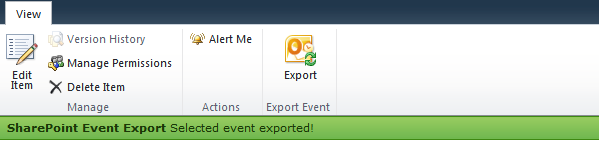
Now next step you need to add your own button in view tab.



Now next step you need to add your own button in view tab.
  • Add new item Event module and give it name “EventModule” ;
  • Add new EventExport.js file in “EventModule”.
  • Add following code in ExportEvent.js File
ExportEvent.js

var clientContext;
var curListId;
var curItemId;
var statusId;
var spSite;
var spWeb;

function exportEvent(itemid, ListID) {

    this.clientContext = SP.ClientContext.get_current();


    this.curListId = ListID;
    this.curItemId = itemid;

    this.spSite = this.clientContext.get_site();
    this.spWeb = this.clientContext.get_web();

    this.clientContext.load(this.spSite);
    this.clientContext.load(this.spWeb);

    this.clientContext.executeQueryAsync(
    Function.createDelegate(this, this.onQuerySucceeded),
    Function.createDelegate(this, this.onQueryFailed)
    );
}

function onQuerySucceeded(sender, args) {

    var webUrl = this.spWeb.get_serverRelativeUrl();
    var iCalUrlPrefix = "/_vti_bin/owssvr.dll?CS=109&Cmd=Display&List=";

    if (webUrl != "/") {

        iCalUrlPrefix = webUrl.concat(iCalUrlPrefix);
    }

    var iCalUrl = iCalUrlPrefix +
    this.curListId +
    '&CacheControl=1&ID=' +
    this.curItemId +
    '&Using=event.ics';


    SP.Utilities.HttpUtility.navigateTo(iCalUrl);

    this.statusId = SP.UI
            .Status
            .addStatus("SharePoint Event Export",
               "Selected event exported!",
                true);

    SP.UI.Status.setStatusPriColor(this.statusId, "green");

    setTimeout(removeStatus, 4000);
}

function onQueryFailed(sender, args) {

    this.statusId = SP.UI
            .Status
            .addStatus("SharePoint Event Export", "Cannot export event", true);

    SP.UI.Status.setStatusPriColor(this.statusId, "red");

    setTimeout(removeStatus, 4000);
}

function removeStatus() {
    SP.UI.Status.removeAllStatus(true);
}

  • Add new empty element in your project.
  • Create a custom Action. 
  • Deploy code on your server.
  • Download the codes from following location

Comments

Popular posts from this blog

SharePoint RPC Protocols Examples Using OWSSVR.DLL

What is SharePoint RPC Protocols? Part 1 This reference includes information about the methods and usage of SharePoint Foundation Remote Procedure Call (RPC) protocol. This protocol can be used in Win32-based applications or in ASPX applications to make HTTP POST requests to the server. Methods in this protocol that do not modify the contents of the database can also be used in URL protocol to make HTTP GET requests. Definition taken from http://msdn.microsoft.com/en-us/library/ms448359.aspx You will find the OWSSVR.DLL in SharePoint 2010 Server Physical Path: C:\Program Files\Common Files\Microsoft Shared\Web Server Extensions\14\ISAPI and MOSS C:\Program Files\Common Files\Microsoft Shared\Web Server Extensions\12\ISAPI OWSSVR.DLL List of commands DialogView  Display ExportList GetProjSchema GetUsageBlob HitCounter RenderView To read more about the OWSSVR.DLL command Please read the URL Protocol from Microsoft Blog having a URL http://msdn.microsoft.com/en...

SharePoint 2013 CTX variable and its function part 1

In this post going to show you some of the useful Utility Functions that might be useful for you while working with search display template. I used most of the functions MSDN Link: https://msdn.microsoft.com/EN-US/library/office/dn768285.aspx CTX Function Part 2   CTX Function Part 3 CTX: In Display template CTX variable is responsible for returning the all the managed properties and other DOM elements. Utility Functions String Functions: For checking Null, Undefined & empty values  Srch.U.w(str): Indicates whether the given string is null, undefined, or empty. $isNull(str): Checking for Null Srch.U.n(str): Indicates whether the given object is null or undefined. $isEmptyString(str) : Checking for an empty string Srch.U.e(str): Indicates whether the string is null or empty. Array Functions: Split & other array related operations Srch.U.getArray(property): Splits the string into an array of strings using the semi colon (";") as a s...

Send Email using SharePoint Rest API

We have a requirement to send email vai SharePoint Rest API. We dig and find the below solution to send email using SharePoint API. Point Must be remember End point " /_api/SP.Utilities.Utility.SendEmail " end point to send email.  In JSON __metadata we used the type " SP.Utilities.EmailProperties ". The User / Group must have a read permission for particular site. where we placed this site code. JS Dependency  JQuery Code URL:  https://gist.github.com/BasantPandey/05189832546f2c6cc0bd008fcfec3264#file-sharepointsendemail-js Code  var Email = function (){ // Email Either email groupname or email address var from = ' abc.yahoo.com ' , to = ' abc.yahoo.com ' , cc = ' abc.yahoo.com ' , subject = ' My Email Subject ' ; this . options = this . options || {}; this . options [ ' fromEmail ' ] = this . options [ ' fromEmail ' ] || {}; this . options [ ' toEmail ...